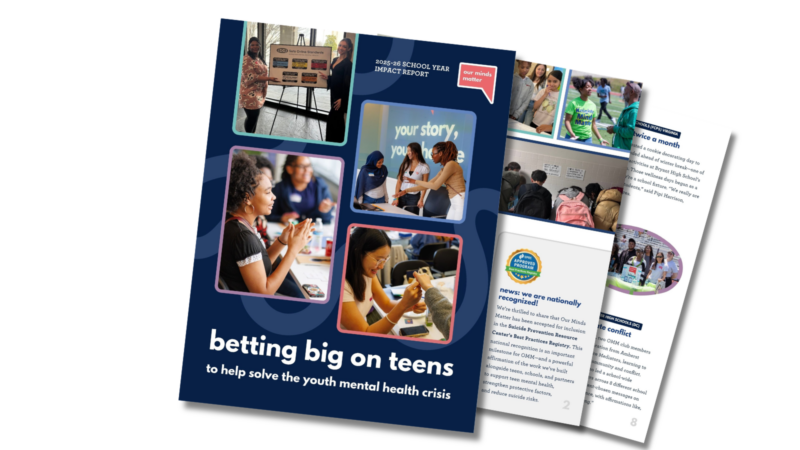
2025-2026 impact report
betting big on teens themselves
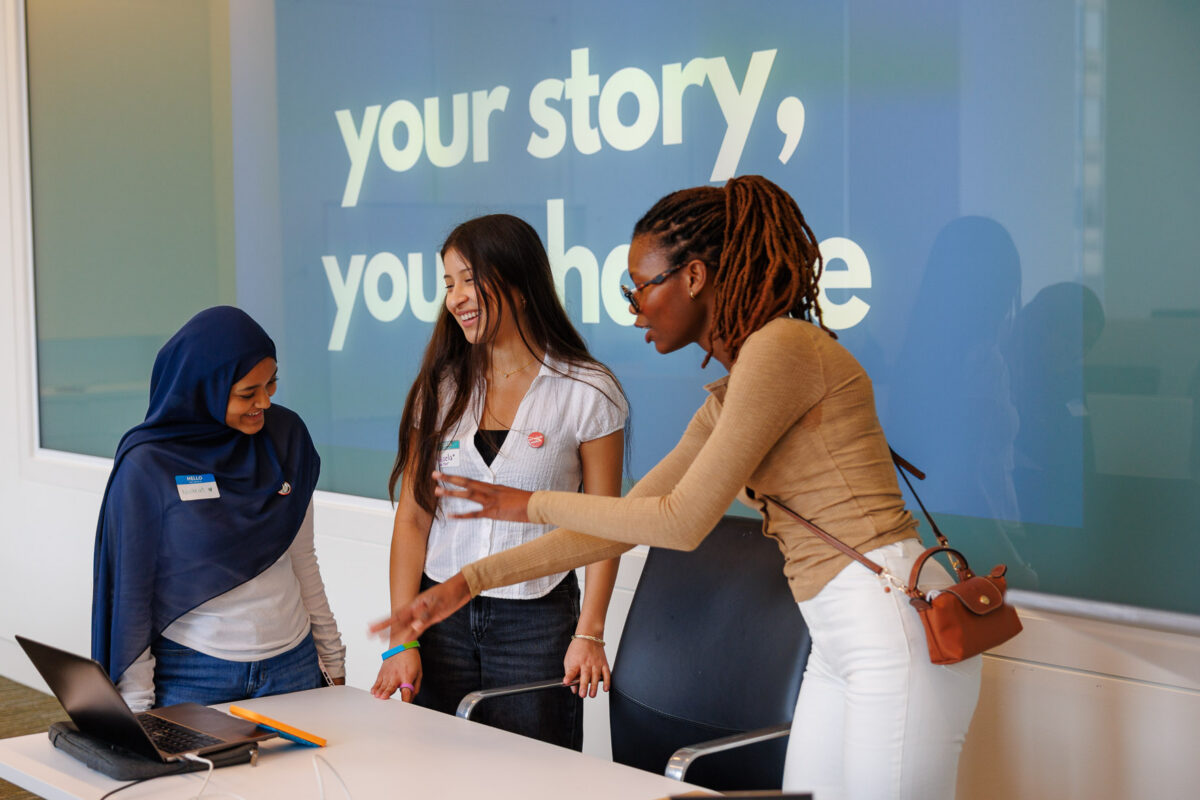
dear friends & supporters,
Reflecting on the 2025-26 school year, I’m filled with gratitude for your support, which has been the foundation of the stories you’ll see below.
Now we’re ready to grow this life-saving work to scale. Our original club model was a response to teens who wanted more than just a one-off awareness event. We’ve since become a beloved tradition at more than 200 schools, across four school district partners, backed by a solid body of data and evidence. Equipped with all of this success, we closed out the 2025-26 school year by approving a new strategic plan—and setting an ambitious goal to increase our impact 5x and reach 500,000+ teens a year by 2030.
In a recent survey, 52% of public schools reported being unable to serve the mental health needs of all teens in their schools, a 10% increase from 2021.
The attention paid to mental health has not been enough. We need new solutions. That’s why OMM is betting big on teens themselves.
As we move forward with our strategic plan to scale, I hope you feel inspired by the stories of teen leadership below—and by the potential for where we’re going next.
With all my gratitude,

 Lauren Anderson
Chief Executive Officer & Co-Founder
—club member“omm actually made me feel that i’m not alone dealing with my mental health.”
individual impact
206 clubs
in high schools, middle schools, and community centers
3,800+ teens
directly participated in clubs
omm clubs foster protective factors shown to reduce suicide risk and promote mental well-being.
among club members in 2025-26:
80%
of participants report feeling socially connected
86%
report practicing self-care and healthy habits
75%
report confidence in supporting peers struggling with mental health
80%
report willingness to seek help
across the 2025-26 school year, omm teen leaders shared life-saving resources and activities, reaching:
school-wide impact
Trend analyses of student perception show a steady, year-over-year decline in mental health stigma across schools.
IRB-approved research shows comfort seeking help from counselors is substantially higher at OMM schools, led by club members (+47%) and evident even among non- participants (+32%), relative to students at non-OMM schools.
Across 5 years in one partner district, students in omm high schools on average reported 0.3% lower rates of suicide attempts than in non-omm schools. that’s 61 teens per year.
omm earns national recognition

We’re thrilled to share our listing in the Suicide Prevention Resource Center’s Best Practices Registry. This national recognition is an important milestone for OMM—and a powerful affirmation of the work we’ve built alongside teens, schools, and partners to support teen mental health, strengthen protective factors, and reduce suicide risks.
meet our scientific advisory council

This new, high-level advisory brings independent guidance to ensure our programs and evaluations are evidence-informed, ethically grounded, and aligned with best practices. We’re honored to have so many distinguished leaders join our inaugural Council: Click here to meet them.
—club member“omm has really helped me gain a sense of stability and social awareness. I deeply value what this club has taught and brought to me.”
club demographics
race/ethnicity
- Black - 34.03%
- White - 22.02%
- Hipanic/Latine - 20.74%
- Asian - 12.91%
- Not categorized - 5.77%
- Multiracial - 4.15%
grade level
- 12th - 33.67%
- 11th - 21.93%
- 10th - 14.33%
- 9th - 12.67%
- 8th - 6.00%
- 7th - 5.83%
- 6th - 5.30%
sexual orientation (high school only)
- Heterosexual - 62.38%
- LGBTQ+ - 19.59%
- Prefer Not to Answer - 18.07%
gender
- Cis-man - 26.50%
- Cis-woman - 63.94%
- Transgender, Nonbinary, Genderqueer - 3.73%
- Not Sure / Prefer Not to Answer - 10.35%
Demographics data sources: Race/Ethnicity, District partner data; Grade level, club sign-in form; Sexual orientation, exit poll (note that data for sexual orientation is only available for high school students); Gender, exit poll. All percentages reported are three-year averages (2023-2026).
system impact
OMM creates impact for individual teens, for entire schools,
and for the school district at large.
We do it by working hand-in-hand with school district leadership. At every level, teens co-design and/or lead the kinds of activities they know their own peers want and need.
Our school district partners report that our teen-centered partnership has:
“substantial” or “transformative” impact in strengthening district-wide mental health initiatives.
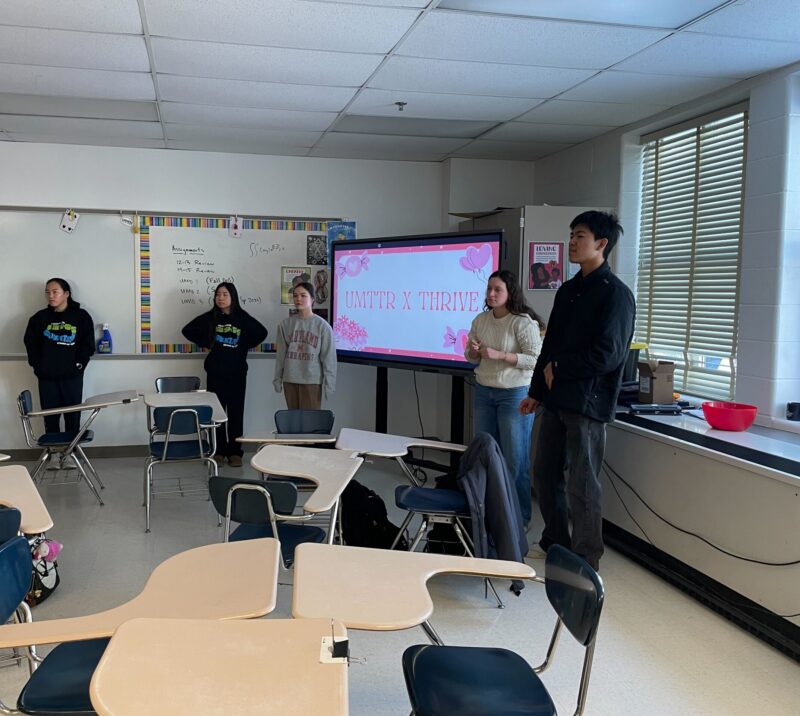
saying "i love me" for valentine's
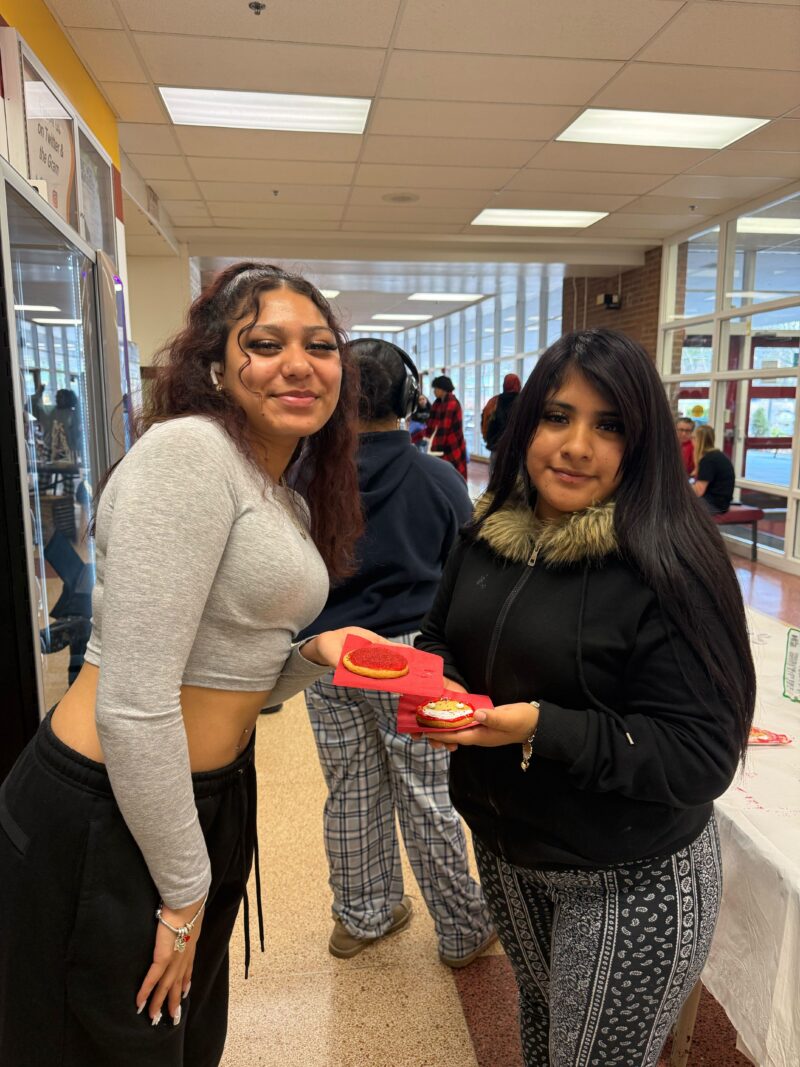
At Winston Churchill High School, student leaders facilitated the “I Love Me” activity for Valentine’s Day, inviting their peers to write down qualities that make them feel strong, confident, and resilient. The club leaders modeled the positive self-talk they hope classmates carry forward, noting that positive self-talk can make a huge difference for teen mental health.
wellness days twice a month
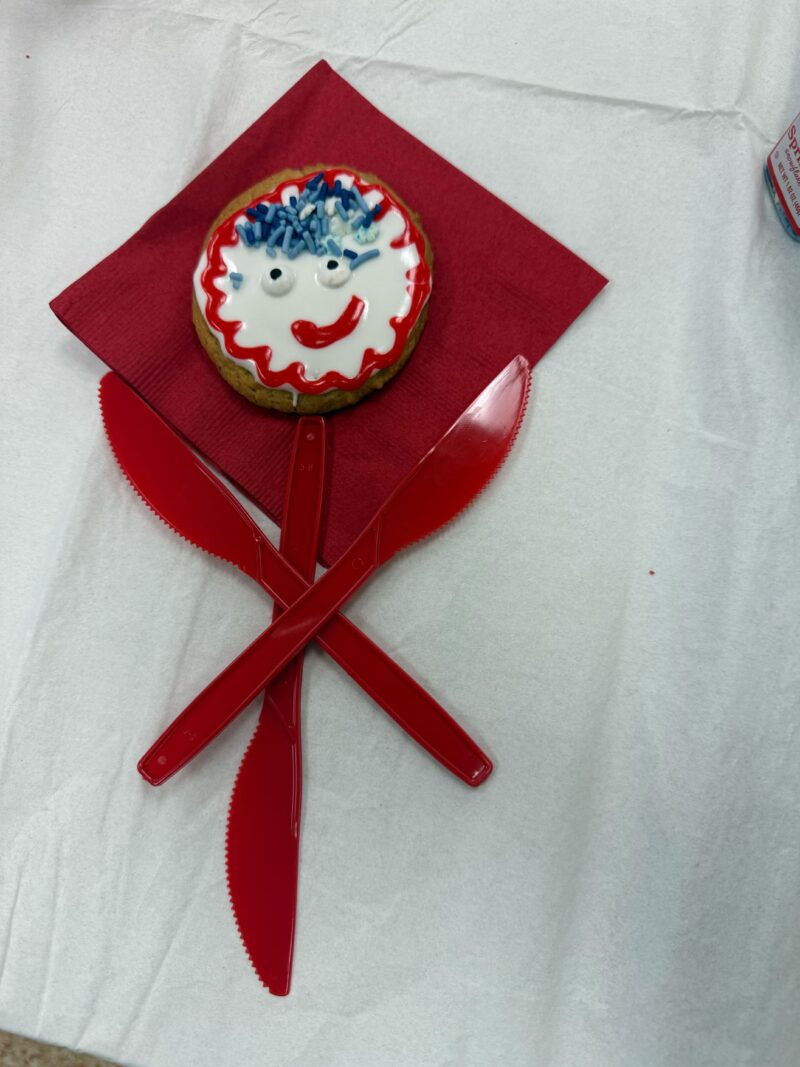
Bryant Minds Matter hosted a cookie decorating day to help students feel grounded ahead of winter break—one of several stress-relieving activities at Bryant High School’s bimonthly wellness days. Those wellness days began as a one-time event; now they’re a school fixture. “We really are in partnership with the students,” said Pipi Harrison, Director of Student Services.

walk and talk for mental health
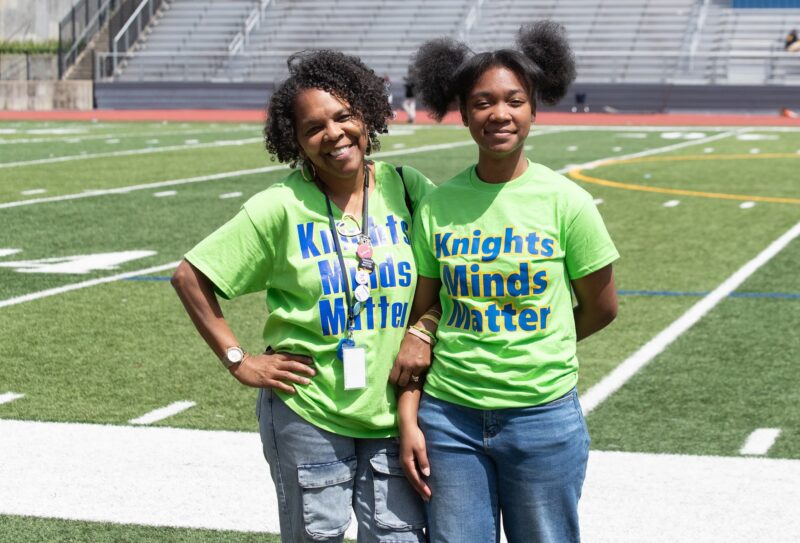
To kick off Mental Health Awareness Month, Knights Minds Matter at Ballou High School hosted its annual Wellness Walk, pairing physical activity with “walk and talk” mental health conversations. More than 300 students, staff, and community members attended, making laps around the track and engaging in conversations about mental health.
learning to mediate conflict
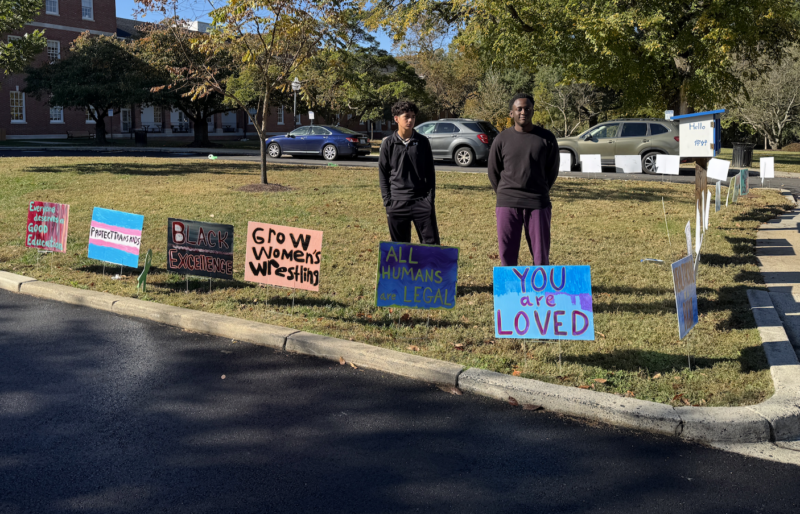
At DC International School, two OMM club members earned an impressive certification from Amherst College as Restorative Justice Mediators, learning to facilitate dialogues around community and conflict. Club leaders at the school also led a school-wide campaign that rallied 20+ peers across 8 different school clubs to create powerful, student-chosen messages on yard signs at the school entrance, with affirmations like, “You are loved” and “You belong.”
—club sponsor“I saw incredible growth in the members of the OMM Club. They appear more social, confident, and settled than in the beginning of the school year when many of them were struggling with socialization and conflict resolution.”
centering teen agency & action
2026 teen leadership summit
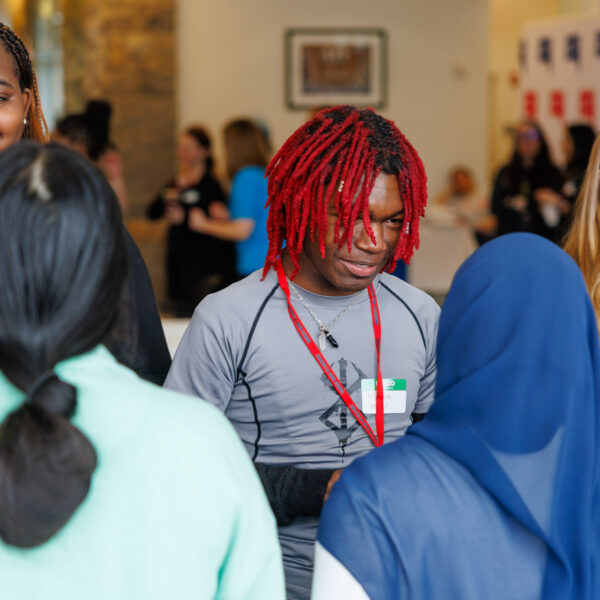
OMM’s Teen Leader Summit brought together over 50 teen leaders from across the DC area to connect, share ideas, and strengthen their work driving mental health change in their schools. True to our teen-led values, our Teen Advisory Council (TAC) members shaped the programming for the day—from the agenda to panel questions to journal prompts.

speaking on capitol hill
OMM teen leaders Jasmin Goodwin and Abhisneha Jones joined national leaders on Capitol Hill in February to help launch the Safe Online Standards (S.O.S.)—a landmark collaboration between mental health advocates, elected officials, and tech companies. The students spoke alongside U.S. Senators Mark Warner (D-VA) and Bernie Moreno (R-OH); tech company reps; and Mental Health Coalition founder Kenneth Cole.
presenting at conferences
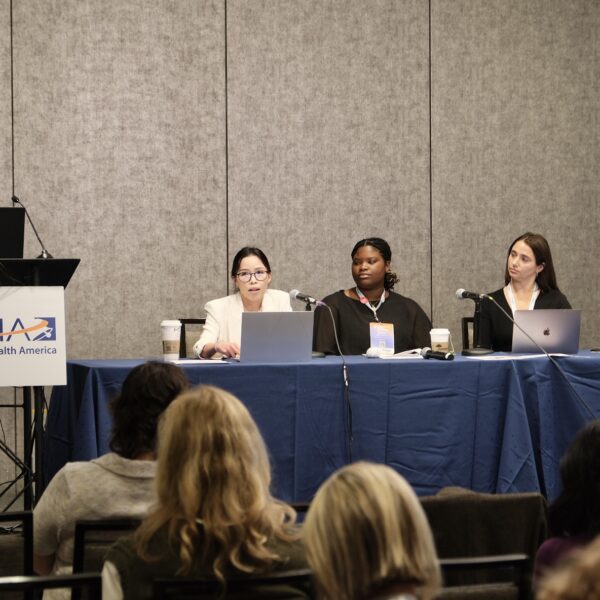
OMM was selected to present at the Mental Health America Conference. OMM teen leader Jasmin Goodwin took the stage alongside our Director of Impact and Chief Programs Officer to talk about how putting teens in the driver’s seat through peer-to-peer, mental health programming can spark sustainable change.
ensuring teens are part of the conversation
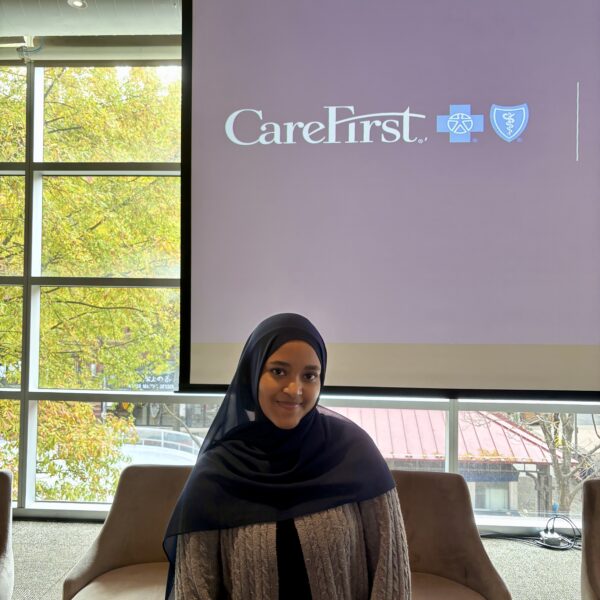
OMM teen leaders also participated as speakers and panelists for major events with Kaiser Permanente; with the Council of State Governments and the AAAS Center for Scientific Evidence in Public Issues, and elsewhere. At the Montgomery County Mental Health Summit, hosted by CareFirst BlueCross BlueShield, OMM teen leader Nushrat Zaima served as the youth keynote speaker.
—club member“OMM has helped me throughout my first year of high school. It greatly changed me as a person and is the only reason I chose to become a leader.”
financials
fy26 revenue: $2,143,385*

* Due to GAAP accounting rules, revenue numbers may vary from the totals in our 990 tax return. We’re happy to clarify specifics upon request.
Our fiscal year runs July 1 – June 30. Our FY25 Form 990 is available for review here. Our FY26 Form 990 will be available in fall 2026; older 990 forms are available on our Partners & Funders page.
our partners







with gratitude to our institutional supporters...
- County of Fairfax, VA
- J. Willard and Alice S. Marriott Foundation
- Jewish Social Service Agency
- The MATTIE Fund
- Born This Way Foundation
- The Devon C. Rubenstein Foundation
- Philip L. Graham Fund
- Capital for Children
- Healthcare Initiative Foundation
- Kettering Family Foundation
- Potomac Health Foundation
- The Wolpoff Family Foundation
- Community Foundation for Northern Virginia
- The Morris and Gwendolyn Cafritz Foundation
- The Rosendin Foundation
- American Psychiatric Association Foundation
- Adventist Healthcare Community Partnerships Fund
- Clark-Winchcole Foundation
- Risa Fund
…. and with gratitude to you!
OMM is a nonprofit organization powered by the generosity of individual mental health champions, state & local governments, and institutional supporters who believe in our impact. Due to space limitations, we are only able to list institutional supporters who contributed $5,000 or more in our 2026 fiscal year (July 1, 2025—June 30, 2026).
We are so thankful for every single donor who contributes to this life-saving mission.
impact report archives