
While many Our Minds Matter clubs are located in the DMV, we are grateful to have a network of dedicated students and school staff across the nation.🧡
This past January, in collaboration with their school’s Black Student Union, AR Minds Matter (ARMM) at Archbishop Ryan High School in Philadelphia, PA, facilitated our Power Flower activity to discuss privilege and power across social identities.
Power Flower helps students talk about how their different backgrounds shape their experiences with privilege — an advantage that is specific to a person or group — and oppression, which occurs when people use their power to unfairly dominate another group. Participants filled out a flower-shaped chart where each “petal” represented a personal identity, like race, gender, socioeconomic class, and others. Talking about power allows students to consider how inequality can affect mental health, especially for those in marginalized groups.
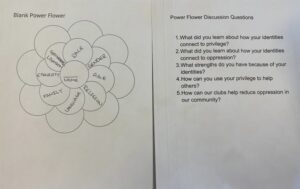
Angelina Dennis, a senior student leader for ARMM, said that the activity sparked meaningful discussion and broadened students’ views on what privilege can look like. For example, some students considered how one’s income bracket can change their access to mental health support. This demonstrates how cost can be a barrier to care depending on socioeconomic status.
“If someone has more income than you, they might be more privileged than you because they’re able to access more resources that they may need to help them,” Dennis said.
Senior student leader Luke Cozzi said that Power Flower also allowed the club to engage the school’s diverse student body. He said that the activity could inspire students to reflect and use their privilege help those with less. Dennis added that people sometimes overlook the advantages they hold, such as being born in a certain country or being able to exercise religious freedom. She said she hopes students are considerate and compassionate toward others with less privileged identities.
“Even if we feel we’re not as privileged as other people …, we’re still privileged in certain ways in comparison to others we may not know,” Dennis said.
In addition to continuing conversations on social identities, ARMM student leaders plan to strengthen their schoolwide impact. For instance, Dennis envisions a club meeting on women’s mental health, while Cozzi is interested in talking about seasonal depression, as many cases may increase during the winter. Cozzi said he understands that for some students, mental health can be a difficult topic to discuss, and that ARMM could help change that.
“Our club gives those kids a space to talk about their mental health,” he said. “Not every kid is comfortable with going to guidance or talking to a counselor.”

We appreciate AR Minds Matter for creating a space for students to learn more about their mental health and others’. These conversations help bridge gaps between communities and allow students to understand how they can celebrate and support peers with different identities. For the latest on ARMM, follow them on Instagram @ar.mindsmatter!💻
Additionally, as we reach the middle of Black History Month, we encourage other clubs to join AR Minds Matter in uplifting Black youth mental health. Our Black Youth Minds Matter Guide includes a glossary, quick facts, activities, and resources to help destigmatize mental health conversations for Black youth and allies.
A special thank you for supporting Our Minds Matter goes to The J. Willard & Alice S. Marriott Foundation; Kettering Family Foundation; The MATTIE Fund; Rosendin Foundation; Van Metre Companies; and our supporter community of mental health champions like you.🌼