As national headlines continue to spotlight the complex role of social media in fueling the youth mental health crisis, a timely conversation unfolded on Wednesday, March 25, when Our Minds Matter (OMM) teen leader, Abhisneha Jones (Northwest High School, ‘26, 24-25 Teen Advisory Council member) joined leading researchers, Dr. Mitchell Prinstein and Dr. Jessica Shleider for a panel discussion. Together, they explored these issues, offering science-backed and balanced perspectives on the nuances of social media, AI use, and youth mental health.
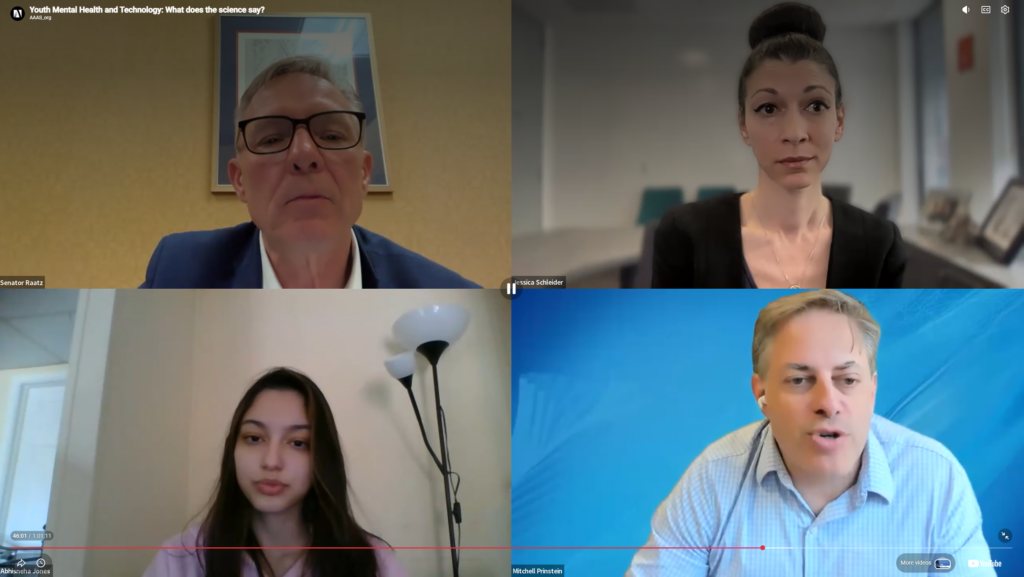
Abhisneha (bottom left) with moderator Indiana Senator Jeff Raatz (top left) and leading experts, Dr. Mitchell Prinstein (bottom right) and Dr. Jessica Schleider (top right)
what the science says
Over 200 participants—including state legislators and their staff from across the country and U.S. territories— joined the webinar, which was hosted in partnership by the Council of State Governments, Our Minds Matter, and the AAAS Center for Scientific Evidence in Public Issues. Moderated by Indiana Senator Jeff Raatz, the session set out to bridge research, lived experience, and policymaking. It opened with a snapshot of the rapidly evolving legislative landscape, followed by insights from Dr. Mitchell Prinstein, Professor of Psychology and Neuroscience at UNC Chapel Hill. He provided a compelling overview of research on adolescent brain development and emphasized the importance of understanding both the harms and benefits of technology across varied applications and contexts.
Dr. Jessica Schleider of Northwestern University then shifted the focus to solutions, highlighting the urgent need for timely, accessible, and equitable mental health care for youth. She shared promising data on single-session, as-needed, online interventions like Project YES—a brief, evidence-based tool designed to meet young people where they are, with built-in connections to crisis and community resources when additional support is needed. She presented a compelling case for how technology can be leveraged to ensure more young people can access mental health support, quickly, privately, and without barriers.
centering youth voice: a teen leader’s perspective
The conversation then turned from research and data to lived experience. Abhisneha brought the teen perspective to the forefront with clarity and conviction. Drawing from her work with OMM, she described how teen-led clubs are creating spaces that “increase mental health awareness, build connection and support, reduce stigma, and make sure teens have accessible mental health resources,” emphasizing that the organization’s true strength lies in its approach and commitment to centering youth voices: “They invite teens to not just be part of the mental health conversations we have, but to help lead them.”
Reflecting on her role in developing a for-youth, by-youth social media guide during her tenure with the Teen Advisory Council, Abhisneha underscored the power of peer-to-peer communication, explaining that when advice comes from other teens, “it feels more honest, and teens are more likely to listen.” She offered a nuanced view of technology in young people’s lives, noting that while social media can foster connections and help teens feel less alone, it can also intensify pressure arising from constant connectivity and comparison. She stressed that “social media isn’t good or bad, but it depends on how we use it,” advocating for guidance that promotes healthy habits rather than avoidance.
Abhisneha also shared her involvement in developing Safe Online Standards in collaboration with the Mental Health Coalition and engaging with policymakers and tech leaders. Looking ahead to emerging technologies like AI, she urged caution, noting that while AI can offer support, “technology should support real relationships, not replace them.” Ultimately, her message was clear: to effectively support teen mental health, young people must be trusted as leaders in shaping the policies and solutions that impact their lives.
OMM is incredibly proud of our teen leader for elevating the youth voice in front of state and local decision-makers—offering critical perspectives on how social media and AI impact young people’s lives, both positively and negatively, and the kinds of support and guardrails that can promote healthier technology use. After all, technology is here to stay. We are also honored and grateful for the opportunity to partner with the AAAS Center for Scientific Evidence in Public Issues on this timely initiative.
If you missed the webinar and would like to learn more, you can watch the recording of the session and review the presentation slides here.